

How are hollow axles manufactured?
May 22, 2025
Hey there! I'm a supplier of hollow axles, and today I'm super stoked to walk you through how these nifty components are manufactured. Hollow axles are pretty crucial in a bunch of industries, like automotive, aerospace, and machinery. They offer a sweet balance between strength and weight, making them a top - pick for many applications.
The Beginning: Selecting the Right Material
First things first, choosing the appropriate material is key. We usually go for high - quality steel alloys, as they provide excellent strength and durability. Some of the common choices include chrome - molybdenum steel and carbon steel. These materials can handle the stresses and loads that hollow axles are subjected to in real - world use.
We source our materials from trusted suppliers who adhere to strict quality control standards. This way, we can be sure that the starting material is up to par and will result in a top - notch hollow axle.
Blanking and Piercing
Once we've got the right material, the first step in the manufacturing process is blanking and piercing. We start with a solid round bar of the chosen material. Using a hydraulic press or a similar machine, we cut the bar into the appropriate length. This is the blank.
After that, we pierce a hole right through the center of the blank. This initial hole will later be enlarged and refined to create the hollow part of the axle. It's a precise operation, and we use high - precision tools to ensure that the hole is centered and has the correct diameter.
Forging
Forging is a critical step in making hollow axles. We heat the pierced blank to a very high temperature, usually in a furnace. The exact temperature depends on the material we're using. Once it reaches the right temperature, the blank becomes malleable, and we can shape it.
We use a forging press to apply a huge amount of force to the heated blank. This compresses the material and refines its grain structure, making the axle stronger. During forging, we also start to shape the outer dimensions of the axle, getting it closer to the final design.
Machining
After forging, the axle needs some fine - tuning. This is where machining comes in. We use a variety of machining processes, such as turning, milling, and grinding.
In turning, the axle is rotated on a lathe, and a cutting tool removes excess material from the outer surface. This helps to achieve the precise diameter and surface finish required. Milling is used to create features like keyways or splines on the axle. It involves using a rotating cutter to remove material from specific areas.
Grinding is the final machining step. It gives the axle an extremely smooth surface finish. A grinding wheel is used to remove a very small amount of material, resulting in a high - precision surface that's perfect for many applications.
Heat Treatment
Heat treatment is another vital process. It helps to enhance the mechanical properties of the hollow axle. There are different types of heat treatment, like quenching and tempering.
Quenching involves rapidly cooling the axle after heating it to a specific temperature. This makes the axle harder and stronger. But quenching can also make the axle brittle, so we follow it up with tempering. Tempering is a process of reheating the quenched axle to a lower temperature and then cooling it slowly. This reduces the brittleness and improves the toughness of the axle.
Surface Treatment
To protect the axle from corrosion and wear, we apply a surface treatment. One common method is coating. We can use different types of coatings, such as zinc plating or powder coating.
Zinc plating creates a thin layer of zinc on the surface of the axle, which acts as a sacrificial layer. If the axle is exposed to a corrosive environment, the zinc will corrode first, protecting the underlying steel. Powder coating is a dry finishing process where a powder is electrostatically applied to the axle and then cured in an oven. It provides a durable and attractive finish.

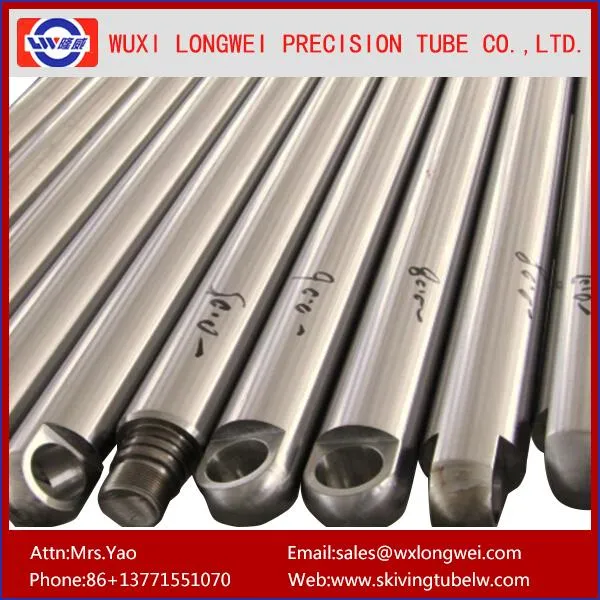
Quality Control
Throughout the manufacturing process, we have strict quality control measures in place. We use a range of inspection tools, such as calipers, micrometers, and coordinate measuring machines (CMMs).
Calipers and micrometers are used to measure the dimensions of the axle, ensuring that they are within the specified tolerances. CMMs are more advanced and can measure the three - dimensional shape of the axle with high precision. We also perform non - destructive testing, like ultrasonic testing, to detect any internal defects in the axle.
Applications of Hollow Axles
Hollow axles have a wide range of applications. In the automotive industry, they're used in vehicles like cars, trucks, and buses. They can be found in the drivetrain, helping to transfer power from the engine to the wheels.
In the aerospace industry, hollow axles are used in aircraft landing gear and other critical components. Their lightweight yet strong nature is ideal for reducing the overall weight of the aircraft, which in turn improves fuel efficiency.
In machinery, hollow axles are used in conveyor systems, robotics, and other equipment. They help to transmit torque and support rotating parts.
Related Products
If you're interested in other related products, we also offer CK45 ST52 Cylinder Double Piston Pole, Oil Cylinder Piston Rod Processing, and Hard Chrome Piston Rod and Hydraulic Chrome Rod. These products are also manufactured with the same high - quality standards as our hollow axles.
Let's Talk Business
If you're in the market for high - quality hollow axles or any of our related products, I'd love to have a chat with you. Whether you're a small - scale manufacturer or a large - scale industrial company, we can work together to meet your specific needs. Just reach out, and we can start discussing your requirements and how we can provide the best solutions for you.
References
- Smith, J. (2018). "Advanced Manufacturing Techniques for Automotive Components". Publisher: AutoTech Press.
- Johnson, R. (2019). "Aerospace Materials and Their Applications". Publisher: AeroBooks Inc.
- Brown, T. (2020). "Industrial Machinery Design and Manufacturing". Publisher: MachTech Publishing.