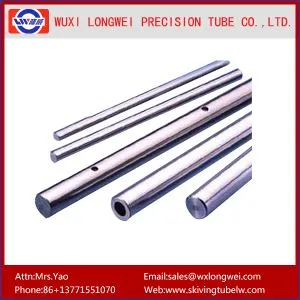
The difference between a solid shaft and a hollow shaft
Nov 08, 2019
Industrial equipment cannot be used in conjunction with the bearing shaft, and its types are various. For example, hollow shafts and solid shafts are the two most obvious types, and for their practicality, which one is more If you are good, of course you need to know through comparison.
We use optical axes on industrial equipment. From the structure, we can simply divide the optical axis into a hollow shaft and a solid shaft. In the case of the same material and the same cross-sectional area, the hollow shaft has stronger torsion resistance than the solid shaft and can withstand large external moments. Axis processing is recognized by Titanium Machinery and quality assurance. In the case of the same external torque, the hollow shaft is chosen to save material compared to the solid shaft. It can also be seen from the stress distribution of the circular section that the maximum shear stress on the circumference of the solid shaft is close to the allowable shear stress, and the shear stress in the middle part is far from the allowable shear stress, and most of the materials in the middle are not fully utilized. Its role. The application of chrome rods is also very extensive.
However, the hollow shaft is more difficult to manufacture than the solid shaft, and the cost is also high. Both are widely used in packaging machinery: filling machinery, filling machinery, wrapping machinery, sealing machinery, labeling machinery, cleaning machinery, drying machinery, sterilization Machinery, strapping machinery, container machinery, multi-functional packaging machinery, packaging material manufacturing machinery, packaging container manufacturing machinery, and auxiliary packaging machinery to complete other packaging operations. The hollow shaft and the solid shaft are more widely used. In actual work, specific analysis is required, and the shape and size of the section are reasonably selected.
The first point, assuming that the outer diameters are the same, the materials are the same, and the heat treatment is the same, the solid shaft is certainly more resistant to bending and torsion than the hollow shaft.
The second point is that the hollow shaft has higher bending and torsion resistance, assuming the same cross-sectional area, the same material and the same heat treatment. However, it is not unconditional. If the wall is too thin, although its moment of inertia and flexural section modulus are high, the compressive stress may cause local instability of the compression zone in the case of bending moment.
The heat treatment conditions mentioned above have no effect on the stiffness but have an effect on the strength.
If the diameter is the same, then whether it is resistant to bending, torsion or tensile, it is stronger than hollow.
If the weight is the same, it is not necessary. It depends on the specific cross-sectional shape. A hollow shaft with a diameter of 100 mm can control the wall thickness and can also have a higher bending resistance than a solid shaft with a diameter of 10 mm.
There are many hollow shafts used in engineering, because the material is not simply looking at the strength, but the so-called specific strength and specific stiffness. An inappropriate example: a solid shaft is 20% stronger than the hollow shaft, but it is 50% heavier. From the engineering point of view, it is more suitable to select the hollow shaft under the premise of high strength.
https://www.skivingtubelw.com