

If you're here, odds are you know how much rides on a good oil cylinder piston rod. As a piston rod processing supplier, I've seen too many projects go sideways because of a small accuracy slip-from a hydraulic lift that won't hold load to a construction crane that underperforms, all because a rod was cut just a hair too short or had a surface rough enough to wear out seals in weeks, not years. Let's break down exactly how we keep our piston rod work dead-on accurate, no shortcuts, and why that's non-negotiable for every part that leaves our shop. First, I'm going to cut to the chase: accuracy in this game isn't just a nice-to-have-it's the whole point. A piston rod's job is to move smoothly inside the cylinder, create consistent pressure, and not fail when you need it most. Even a 0.001-inch deviation in diameter, a few thousandths of an inch of runout along the length, or a surface that's not ground to the right finish can turn a $500 part into a $5,000 repair bill.
Let's start with the foundation: the raw material. You can't make an accurate piston rod if you start with scrap stock that's already warped or off-spec. We work with only vetted mills that provide certified material reports-nothing gets cut until those specs check out. Most of our standard parts use CK45 carbon steel, but we also do a ton of stainless steel for corrosive environments, like food and beverage or marine. For those, we have two go-to options: Stainless Steel 304 Hydraulic Precision Piston Rod for general corrosion resistance and 316 Stainless Steel Hydraulic Precision Piston Rod for harsher stuff like saltwater or acidic chemicals. We don't mess around with off-brand material here-using the right base stock eliminates 30% of accuracy issues before machining even starts.
Next up, the machining process, and this is where most shops cut corners. I've seen guys set up a lathe and run a rod without checking for tool wear, and by the time they finish, the diameter's 0.002 inches bigger on one end than the other. At our shop, we use CNC machines calibrated daily-not just when the shift starts, but every time we switch materials. We track tool life religiously; each insert is replaced after a set number of parts, not when it looks dull. For rough cuts, we leave a consistent 0.015-0.020 inch of material to take off in finish passes-too little, and you'll burn the surface and get inaccurate measurements; too much, and you'll waste time and risk warping the part from too much pressure.
Then there's the heat treatment, which is make or break for hardness and dimensional stability. A lot of shops skip proper heat treatment or do it haphazardly, and that leads to a rod that's hard on the surface but soft inside, or worse, warped so bad after quenching it's impossible to machine accurately. We use high-frequency quenching and tempering for most of our carbon steel rods-this method heats the surface quickly (no risk of overheating the whole part) and cools it evenly, leaving the core tough and the surface hard enough to resist wear. We don't do this in-house? Wait, no, we do-we have our own high-frequency heat treat line, so we control every step. After heat treatment, we always stress-relieve the rods. That means heating them to a specific temperature and letting them cool slowly to remove any internal stresses that would cause the rod to twist or bow later when we machine it. Without stress relief, a rod might check out on the measurement table today and be 0.005 inches off tomorrow-total headache, and we won't let that leave our shop.
After heat treat comes the grinding phase, where accuracy really gets locked in. Turning is great for shaping, but grinding is what gets us to the tight tolerances we need (we usually hold +/-0.0005 inches on diameter for precision parts). We use centerless grinding for most rods because it's consistent, but for parts with tight length or step tolerance, we use center grinding. The key here is coolant-we use a high-pressure, filtered coolant that keeps the grinding wheel clean and the part at a constant temperature. If a part gets too hot during grinding, it expands, and when it cools down, it shrinks, throwing off all our work. We also check dimensional measurements every 10 parts, not just the first and last. And for surface finish-we aim for a Ra of 0.2 to 0.8 microns depending on the application-because a too-rough surface will eat through piston seals, even if the dimensions are perfect.
Wait, what about special types of rods, like hollow ones? A lot of construction equipment uses CK45 Hollow Piston Rod because they're lighter but still strong, and they're trickier to machine than solid ones. If you're drilling a hole down the center, the tool can flex, leading to a crooked bore, which makes the rod unstable. For hollow rods, we use specialized fixturing to hold the part tight while drilling, and we use a peck drilling cycle to break up chips and reduce tool flex. We also check the bore diameter and concentricity with a gauge that runs along the entire length-if the bore is off-center, the rod won't align properly in the cylinder, no matter how perfect the outer diameter is.
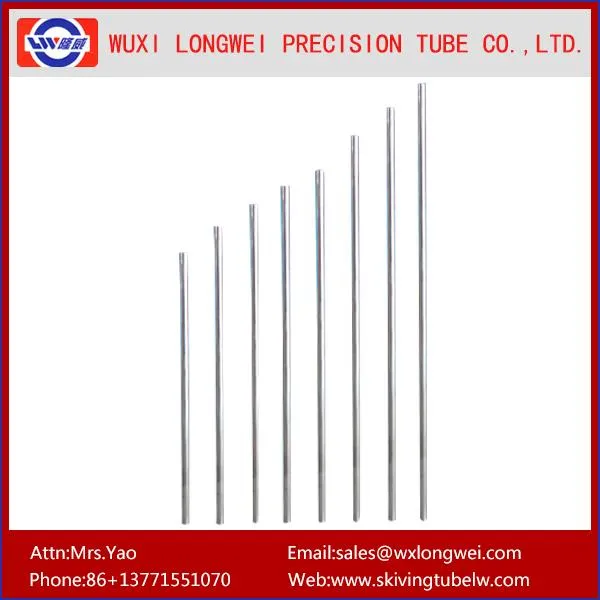
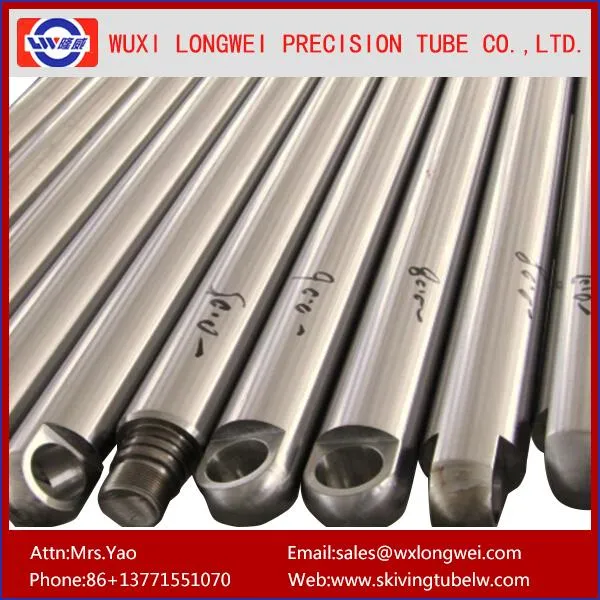
Now, inspection-this is where we don't cut corners. After every step, and definitely before a part ships, we do full inspections. We use coordinate measuring machines (CMMs) for complex geometries, micrometers with digital readouts for diameter checks, runout gauges to make sure the rod isn't twisted along its length, and surface profilometers to check the finish. We don't just measure random points-we check the entire length of the rod for taper, because even a 0.001-inch taper over a 6-foot rod is enough to cause binding in the cylinder. For critical parts, we even do a functional test: we assemble a mock cylinder, slide the rod in, and cycle it 100 times to make sure it moves smoothly without sticking or leaking (though we don't use actual hydraulic fluid for the test, just pressure and movement).
Something a lot of people forget is fixturing and setup. If your part isn't held correctly in the machine, you can't get accurate measurements, plain and simple. We use custom fixturing for every rod type-no generic chucks. For long rods, we use tailstocks to support the end and prevent bending during machining. When setting up a new job, one of our senior machinists spends 15 minutes checking the alignment of the machine, the fixture, and the part before even hitting the start button. I've seen newer machinists skip this and end up with a whole batch of parts that are off by 0.01 inches-total waste, and not something we tolerate here.
We also keep detailed records for every single part that leaves our shop. That means if a customer has an issue down the line, we can pull their order, see exactly what material was used, what tools we ran, what measurements we took, and what heat treat cycle was used. It's not just good for quality control-it builds trust. Our customers know that if they order a piston rod from us, they're not getting a random part off the shelf; they're getting a part that was made with consistent, traceable steps.
Wait, let's talk about common mistakes we see other shops make that lead to accuracy issues. One is skipping stress relief after heat treatment-like I said earlier, that leads to dimensional shift. Another is not calibrating measuring tools regularly. If your micrometer is off by 0.002 inches, all your measurements are wrong. We calibrate every measuring tool once a week, plus we do a spot check every day against a master gauge. Another big one is rushing the finish grind-taking too deep of a cut, which heats up the part and causes expansion, leading to final measurements that are wrong once the part cools.
At the end of the day, when you're a piston rod processing supplier, your reputation lives or dies on accuracy. A customer's machine isn't going to work right if their piston rod is off-spec, so we go above and beyond to make sure every part we ship meets or exceeds their requirements. If you're in the market for reliable, high-accuracy oil cylinder piston rods-whether you need standard carbon steel, stainless steel, hollow rods, or the high-frequency quenched and tempered variety-we've got you covered. We work with customers across industries, from agriculture to aerospace, and we can handle small custom orders to large production runs. If you're tired of dealing with piston rod suppliers that cut corners on accuracy, let's connect to talk about your project and how we can deliver the parts you need, every time.


