

If you've ever worked with hydraulic systems, you know the piston rod is the unsung hero- it's the part that extends and retracts to transfer force, keep pressure tight, and make everything from construction lifts to factory assembly lines run smoothly. But not all piston rods are made equal. Last year, my team at [our company] took on a job for a client who needed a piston rod with a weird, non-circular profile-think curved flanges, notches that had to line up within a hair's breadth, and a surface that couldn't just be smooth, it had to resist corrosion and wear in a dusty, outdoor mining operation. That project turned into a crash course in just how messy and tricky processing complex-shaped oil cylinder piston rods can be. If you're in the piston rod game, you've probably run into these same headaches, and if you're new to making these parts, this is the stuff they don't teach you in basic machining 101.
First off, let's talk about the material. A lot of piston rods are straightforward-we make tons of standard rods like the 40Cr Chrome Hydraulic Cylinder Piston Rod for general-purpose hydraulics, or the 42CrMo4 Piston Rod for higher-stress applications like cranes. But when you're dealing with a complex shape, the material picks you're forced into make or break everything. Our mining client wanted a rod that could handle saltwater (from de-icing) and abrasive rock dust, so we went with stainless steel-initially, we tried the 316 Stainless Steel Piston Rod because it's corrosion-resistant, but man, machining 316 is a nightmare for intricate shapes. It's gummy, like cutting warm peanut butter, which makes it easy to get uneven cuts or built-up edge on the tool. Later, we switched to Stainless Steel 304 Hydraulic Precision Piston Rods for a different complex job because it's a bit less gummy, but it still has its own quirks. The problem with complex shapes is that you can't just mill a round bar into a weird form without accounting for how the material will act under pressure. If you pick the wrong material for the shape, you're going to have to redo parts twice as often, and that kills lead times.
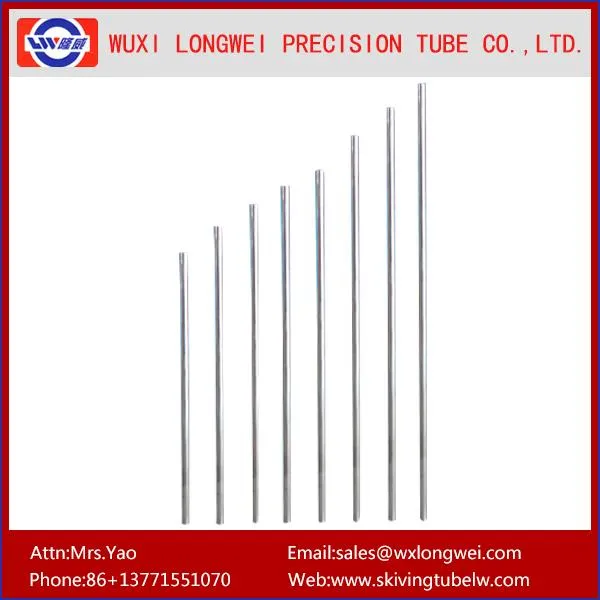

Next up: tooling and setup for those shapes. When you're making a plain round rod, you can use a standard lathe, fix it between centers, and go. But when you have a non-symmetric profile-say, a rod with a helical notch or tapered flanges on both ends-you need custom tooling, or at the very least, a CNC setup that's programmed to move in more than two axes. On that mining project, we needed a rod with three precision notches that had to be aligned within 0.02mm across the entire length. Using a standard end mill would have left rough edges and wrong angles, so we had to spec a custom form tool. But here's the catch: complex shapes mean the tool has to follow exactly the profile, and any tiny mistake in the tool's geometry (like a micro-chip in the cutting edge) shows up big time on the part. We lost three days waiting for that custom tool to be made, and when we finally used it, we had to do test cuts on a scrap bar for another two days to get the program right. Even with a fancy CNC, setup for complex shapes isn't just locking the part down-you have to account for tool deflection, especially with long rods. If the tool bends just a little while cutting a deep, narrow notch, the shape is off, and the rod won't fit into the cylinder. We learned that the hard way when a batch of our custom-shaped rods came back with notches that were 0.1mm too shallow-nothing sounded like a big number, but it meant the client's seals wouldn't seat properly, so we had to re-do all 20 parts.
Then there's dimensional accuracy and tolerance stacking. This is where complex shapes really separate the pros from the amateurs. A standard round piston rod only has a few key specs: diameter, straightness, surface finish. A complex shape? You've got linear dimensions, angles, positions of features, surface roughness on multiple faces, and straightness along curved sections. On that same mining rod, we had to hit ten different tolerance specs, some as tight as ±0.01mm. The problem is, each machining operation adds a tiny bit of error, and when you stack them up, even small errors from each step add up to a part that doesn't meet the mark. For example, when we milled the curved flanges, we set the CNC to move along a 3D path, but the machine's own backlash (play in the axes) made the flange width vary by 0.03mm from end to end. We tried compensating in the program, but that backfired because each rod was a little different-since we were using solid bars, there was minor variation in the raw material's diameter, which threw off the compensation. We ended up having to use a coordinate measuring machine (CMM) to check every single feature after each step, which added hours to the process. And if you mess up even one tolerance, the whole part is useless. One of our guys missed a tiny angle on a notch, and the client couldn't install the rod without modifying their cylinder-we had to replace it for free, which ate into our margin and made us promise to double-check every angle next time.
Surface finish is another big one, especially for hydraulic piston rods because the rod's surface seals against the cylinder's seals. If you have a complex shape, you can't just polish the whole thing the same way-different areas have different geometries that make polishing uneven. Our Hard Chrome Piston Rod and Hydraulic Chrome Rod parts are usually polished to a Ra of 0.2μm, but on a curved shape, buffing with a standard wheel leaves high spots and low spots. We tried robotic polishing, but the robot's path had to be programmed exactly to the part's shape, and if the curve wasn't perfectly uniform, the robot would over-polish some areas and under-polish others. We even went back to hand polishing for critical areas, but that's inconsistent and slow. On a recent project for a construction company, their complex rod had a tapered end that needed a perfect surface to fit a seal. We ran two batches through robotic polishing and they came back with Ra values all over the place, so we had to take 2 days to hand-finish each rod, which pushed the delivery date out by a week. That client almost switched to another supplier because we were late-lesson learned: surface finish on complex shapes isn't a "set it and forget it" job.
Wait, let's not forget about distortion. When you're cutting a lot of material to make a complex shape, you're removing a ton of stress from the raw bar, and that makes the part warp. For example, when we milled out a big notch on one side of a steel rod, the remaining material on the opposite side had less stress holding it straight, so the rod bent by 0.5mm after machining. That's a problem because the rod needs to be straight to slide smoothly in the cylinder. We tried stress-relieving the parts after rough cutting, but heating a shaped rod can make the shape change too-you have to hold it in a jig while it cools, which is another setup step. If you don't hold it right during stress relief, the part twists, and you have to grind it straight, which might mess up the surface finish. We had one batch of rods that twisted so bad after stress relief that we had to throw half of them away, which was a total waste of material and time.
And finally, there's quality control (QC) that's more intense. For a standard rod, you might use a micrometer to check diameter, a surface roughness tester, and a straightedge. For a complex-shaped rod, you need a CMM that can map the entire 3D profile, or even a laser scanner to check for deviations. Each measurement takes longer, and if the shape is weird, you might have to make custom fixtures to hold the part for testing so it doesn't move around and throw off the reading. On that mining project, we had to buy a new CMM program just to scan the curved flanges, which cost us a few hundred bucks, but it was better than sending bad parts. QC also means more rework-if a part is slightly off, you can't just machine more material like you can on a round rod; you might have to grind specific areas, or even send it out for special coating to fix a surface issue. We recently had a customer with a complex piston rod that had a small scratch on a curved section, so we had to use a specialized coating to cover it, which took an extra day.
At the end of the day, processing complex-shaped oil cylinder piston rods isn't like making the standard rods we crank out every day. It's a mix of getting the material right, custom tooling that works, precise programming, constant QC, and dealing with all the little unexpected hiccups (like a tool chip, distorted parts, or measurement errors) that come with weird shapes. We've learned a ton from those messy jobs-now we keep spare custom tooling on hand, test material batches upfront, and double-check every tolerance at every step. If you're dealing with complex piston rod needs, we've got the experience to get it right. Whether you need a specialized alloy rod, a stainless steel part, or a custom-shaped one for your hydraulic system, we're here to work with you. Reach out to us to discuss your requirements, and we'll walk you through every step of the process to make sure your piston rod is exactly what you need.


